
Managing welding procedures, approvals, and compliance records across ASME-governed projects creates real operational risk when documentation lives in spreadsheets, shared folders, and disconnected filing systems. For inspection and quality managers, one expired welder qualification or a misrouted procedure approval can delay production and trigger costly requalifications.
CEI's welding documentation software, ProWrite, gives ASME compliance teams structured control over every procedure, qualification, and signature in a single governed system. But ProWrite is not the only option on the market. This article compares the welding approval software platforms that inspection and quality managers should evaluate when choosing a documentation system built for coded project traceability.
Quick guide: 5 best welding approval software for ASME teams
- CEI ProWrite: The best welding approval software for ASME compliance teams that need code-assisted document creation, automated approval workflows, and audit-ready reporting across multiple code standards.
- WeldTrace: Cloud-based welding management platform with WPS, PQR, and WPQ creation tied to project-level weld tracking and turnover pack assembly.
- Codeware Shopfloor: Welding procedure and quality control software with real-time ASME IX and AWS code checks during form creation.
- Octave Aspect Pressure Vessel: Engineering analysis software for pressure vessel design calculations with compliance reporting and multi-code support.
- WELDET by ASTRAM: Welding lifecycle management platform connecting procedures, qualifications, inspections, NDT, and data book generation in one system.
How we chose the best welding approval software for ASME compliance
Selecting welding software for ASME compliance teams is not a generic SaaS evaluation. The tools need to handle code-specific logic, controlled document lifecycles, and audit demands that general quality management platforms cannot address. Here is what we evaluated:
- Code compliance depth: Does the software check essential variables against ASME Section IX, AWS D1.1, or API 1104 as you build procedures? Built-in code logic helps you catch errors before they reach an Authorized Inspector.
- Approval workflow control: Can you route WPS, PQR, and WPQ documents through defined review and signature stages? Controlled workflows reduce the chance of unapproved procedures reaching the shop floor.
- Welder qualification tracking: Does the platform monitor continuity dates, send expiration alerts, and link each welder's qualifications to the procedures they support? This prevents production delays caused by lapsed certifications.
- Audit-ready reporting: Can the system generate compliance reports, qualification summaries, and procedure submittals that are ready to hand to an inspector or client without manual formatting?
- Multi-code support: Does the software cover the range of codes your shop needs, from ASME Section IX and AWS D1.1 to API 1104, BS/EN/ISO, MILSPEC, and NAVSEA?
- Project traceability: Can you trace each weld back through its procedure, welder qualification, inspection record, and material certification to create a defensible documentation chain?
The 5 best welding approval software for ASME compliance teams
1. CEI ProWrite: Best overall welding approval software for ASME compliance teams
CEI ProWrite is purpose-built for engineers and quality teams who need to create, manage, and maintain Welding Procedure Specifications (WPS), Procedure Qualification Records (PQR), Welder Performance Qualifications (WPQ), and continuity records under ASME Section IX and AWS D1.1.
What sets ProWrite apart from general welding management tools is its code-assistance engine. As you build a procedure document, ProWrite checks essential variables against the applicable code edition and flags discrepancies before they become audit findings. This means your procedures are validated during creation rather than caught during review.
ProWrite also handles API 1104 pipeline welding workflows, giving teams working across multiple codes a single platform for all their procedure documentation. The software includes automated welder expiration notifications, so your quality team knows when a qualification is approaching its continuity deadline before it becomes a production problem.
CEI delivers ProWrite in both cloud-based and on-premise configurations with single-user and concurrent-user licensing. That flexibility lets you match the deployment to your IT requirements, whether your shop runs a centralized system or needs offline access at fabrication sites.
ProWrite features
- Code-assisted document creation: ProWrite guides you through PQR, WPS, and WPQ creation with built-in ASME Section IX and AWS D1.1 code checks that validate essential variables in real time, reducing documentation errors before they reach an inspector.
- Automated welder continuity tracking: The platform monitors every welder's qualification status and sends automated email notifications when continuity deadlines approach, helping you avoid costly requalification events.
- Multi-code coverage: Beyond ASME Section IX and AWS D1.1, ProWrite supports API 1104, BS/EN/ISO, MILSPEC, and NAVSEA codes, so teams working across commercial and defense welding procedures can manage everything from one system.
- Electronic signature workflows: Route documents through defined approval stages with electronic signatures, creating a traceable chain of review and authorization for every procedure in your library.
- Comprehensive material libraries: Built-in filler metal and base material databases let you select materials directly within the procedure document, reducing manual lookups and transcription errors.
- Audit-ready compliance reports: CEI ProWrite generates ready-to-submit procedure submittals and compliance reports that can go directly to an Authorized Inspector or client without manual reformatting.
ProWrite pros and cons
Pros:
- Code-assistance engine validates essential variables against the current ASME Section IX and AWS D1.1 code editions during document creation, catching errors before submission.
- Broadest multi-code support among welding procedure platforms, covering ASME, AWS, API, BS/EN/ISO, MILSPEC, and NAVSEA from a single interface.
- Responsive customer support from certified engineers who understand welding codes and fabrication workflows, not generic help desk staff.
Cons:
- The breadth of code packages and configuration options means your team will benefit from the included training resources to get the most from the platform.
- On-premise deployments require coordination with your IT team for installation and updates, though the cloud option avoids this entirely.
- The focus on procedure documentation and compliance means fabrication-level project management (scheduling, material tracking) is handled by CEI's Fabrication Manager as a separate integrated product.
2. WeldTrace: Cloud-based weld lifecycle management with project tracking
WeldTrace is a cloud-based welding management platform that connects WPS and PQR records, welder qualifications, drawings, weld maps, inspection records, NDT tracking, and turnover pack assembly in one system. It supports ASME IX, AWS D1.1, AWS D1.2, AWS D1.5, AWS D1.6, API 1104, ISO 15614-1, and ISO 9606-1 for generating code-compliant documentation.
The platform includes a base metal database with over 5,000 materials and a filler metal library with over 4,000 entries. WeldTrace also manages welder continuity automatically and sends warning emails when qualifications approach expiration. For teams that need project-level traceability from procedure qualification through data book handover, WeldTrace offers a connected record for each weld.
WeldTrace features
- End-to-end project traceability: Links drawings, weld maps, materials, welders, inspection records, and NDT results to each weld for a connected project documentation chain.
- Multi-code procedure creation: Generates code-compliant WPS, PQR, and WPQ/WQTR documents for ASME IX, AWS D1.1, API 1104, ISO 15614-1, and ISO 9606-1.
- Turnover pack assembly: Compiles completed project records into organized data books and turnover packs for client handover.
WeldTrace pros and cons
Pros:
- Connects procedure qualification records through to project-level weld tracking and data book assembly in a single platform.
- Includes mobile app support for metric and US customary units with private cloud and on-premise hosting options available.
- No limits on managing welders and their qualifications regardless of plan tier.
Cons:
- Code-compliant document generation covers a narrower set of standards compared to platforms that also include MILSPEC, NAVSEA, and BS/EN/ISO procedure forms.
- The procedure creation workflow does not include real-time essential variable validation against code editions during document authoring.
- Users who bring their own WPS and PQR documents created elsewhere can manage them in the system but cannot apply code checks to those imported records.
3. Codeware Shopfloor: Real-time code checks during WPS creation
Codeware Shopfloor is a cloud-based welding procedure and quality control platform that performs real-time ASME IX and AWS code checks as you create welding forms. The software supports ASME IX weld forms (PQR, pWPS, WPS, SWPS, WPQ, WOPQ), AWS D1.1, D1.3, D1.5, and D1.6 forms, and National Board forms. Shopfloor includes an exclusive partnership with AWS for their Standard Welding Procedure (SWPS) database lookup.
The platform integrates with Codeware's COMPRESS pressure vessel design software and INSPECT fitness-for-service application. For fabrication shops already using the Codeware ecosystem, Shopfloor offers a connected workflow from vessel design through welding procedure documentation.
Codeware Shopfloor features
- Real-time code deficiency detection: Reports code check results with references to specific ASME IX and AWS code paragraphs during form creation.
- AWS SWPS database integration: Searches the complete AWS Standard Welding Procedure database and loads purchased SWPSs directly into Shopfloor.
- Welder continuity tracking: Monitors welder qualifications and sends email alerts for pending and expired certifications.
Codeware Shopfloor pros and cons
Pros:
- Code checks reference specific ASME IX and AWS code paragraphs, giving QC personnel detailed compliance verification during procedure creation.
- Integrates with Codeware's COMPRESS and INSPECT products for fabrication shops that use the Codeware design ecosystem.
- Supports electronic signatures and custom form templates for shops that need to maintain their existing document layouts.
Cons:
- Code support does not extend to API 1104, MILSPEC, NAVSEA, or BS/EN/ISO standards, which limits coverage for shops working across multiple code frameworks.
- The platform's primary integration advantage ties to Codeware's own product suite rather than third-party CAD, ERP, or design tools.
- Project-level weld mapping, NDE tracking, and turnover pack assembly are not included in the platform's scope.
4. Octave Aspect Pressure Vessel: Engineering analysis with compliance reporting
Octave's Aspect Pressure Vessel (formerly PV Elite) is an engineering analysis tool for pressure vessel and heat exchanger design. It evaluates entire vessels against global codes including ASME Section VIII Divisions 1 and 2, with fitness-for-service analysis per API 579. The software includes interoperability with Octave's Forte 3DWorx design tools and Aspect Pipe Stress for connected design-to-analysis workflows.
While Aspect Pressure Vessel focuses on the design and analysis side rather than welding procedure documentation, it complements ASME compliance workflows by providing code-compliant vessel calculations and exportable reports. Teams that need both design validation and welding documentation may use Aspect alongside a dedicated welding procedure platform.
Octave Aspect Pressure Vessel features
- Multi-code vessel analysis: Performs pressure vessel calculations against ASME Section VIII Div. 1 and Div. 2, EN 13445, PD 5500, and other regional standards.
- Fitness-for-service integration: Includes native API 579 fitness-for-service analysis for evaluating in-service equipment.
- Design tool interoperability: Connects with Octave's Forte 3DWorx and Aspect Pipe Stress for a design-through-analysis workflow.
Octave Aspect Pressure Vessel pros and cons
Pros:
- Covers multiple international pressure vessel codes beyond ASME, including EN 13445 and PD 5500, for teams working on global projects.
- Includes native API 579 fitness-for-service capabilities without requiring a separate software purchase.
- Offers interoperability with Octave's piping and structural analysis products for multi-discipline engineering teams.
Cons:
- Does not include welding procedure documentation (WPS, PQR, WPQ), welder qualification tracking, or approval workflow management.
- The platform focuses on design and analysis calculations rather than fabrication-level document control and compliance reporting.
- Integration with third-party welding documentation systems requires manual data transfer between platforms.
5. WELDET by ASTRAM: Full welding lifecycle management for fabrication projects
WELDET is a welding management platform from ASTRAM that covers the full fabrication lifecycle. It connects WPS and PQR management, welder qualifications, weld mapping, inspections, NDT, consumable tracking, nonconformance reports, and data book generation. The software supports ASME IX, AWS D1.1, and EN ISO 15614 standards.
WELDET uses a controlled source-of-truth approach where every record stays linked to the relevant project, drawing, and weld. The platform provides live status visibility from shop to site, with guided workflows for each stage from procedure engineering through final reporting.
WELDET features
- Stage-based fabrication workflow: Guides teams through procedures, qualification, planning, execution, inspection, and reporting stages with linked records at each step.
- Live project visibility: Provides real-time status for every weld across all active projects, from qualification through completion and handover.
- Data book generation: Assembles completed project records into structured data books and client deliverables.
WELDET pros and cons
Pros:
- Covers the entire welding lifecycle from procedure creation through inspection, NCR management, and data book assembly in a single platform.
- Includes consumable tracking and material certificate management alongside welding procedure documentation.
- Provides shop-to-site visibility with live weld status tracking across all active fabrication projects.
Cons:
- Code support does not extend to API 1104, MILSPEC, or NAVSEA procedures, which limits applicability for pipeline and defense fabrication teams.
- The platform does not include built-in code-assistance logic that checks essential variables during WPS and PQR creation.
- As a newer platform, the user community and available third-party training resources are smaller than more established welding documentation tools.
Comparison table: The best welding approval software for ASME compliance
| Platform | Code-Assisted Creation | Multi-Code Support | Electronic Signatures |
|---|---|---|---|
| CEI ProWrite | ✓ | ASME IX, AWS, API, ISO, MILSPEC, NAVSEA | ✓ |
| WeldTrace | ✗ | ASME IX, AWS, API, ISO | ✗ |
| Codeware Shopfloor | ✓ | ASME IX, AWS | ✓ |
| Octave Aspect PV | ✗ | ASME VIII, EN, PD (design only) | ✗ |
| WELDET | ✗ | ASME IX, AWS, EN ISO | ✓ |
What should ASME compliance teams look for in welding approval software?
The difference between a useful welding documentation platform and one that creates more work than it solves often comes down to code awareness. Software that checks essential variables against ASME Section IX or AWS D1.1 during document creation catches errors at the source, before they compound through review cycles and production.
Approval workflow control matters just as much. When your WPS, PQR, and WPQ documents move through defined review and signature stages with a traceable history, you can demonstrate to an Authorized Inspector exactly who reviewed what and when. That traceability is what turns documentation from an administrative task into an operational safeguard.
Teams running ASME-governed fabrication projects should also consider how well the platform handles welder qualification continuity. Expired qualifications create production stops that ripple through project schedules. Automated notifications tied to each welder's continuity dates keep your team ahead of those deadlines.
How does coded project traceability reduce audit risk for fabrication teams?
Coded project traceability means every weld in your documentation system links back to its governing procedure, the welder's qualification record, material certifications, and inspection results. When an auditor or Authorized Inspector asks about a specific joint, you can pull the complete documentation chain in seconds rather than searching through filing cabinets or shared drives.
This level of traceability does more than speed up audits. It surfaces gaps in your documentation before they become findings. If a welder's qualification does not cover the procedure assigned to a joint, a traceable system flags that mismatch at assignment time rather than during the audit itself.
CEI ProWrite supports this traceability by linking every procedure document to the code edition, essential variables, and qualification records that support it. When integrated with CEI's Fabrication Manager, your documentation chain extends from procedure creation through project-level tracking and compliance reporting.
Why CEI ProWrite is the best welding approval software for ASME teams
CEI ProWrite addresses the specific operational pain points that inspection and quality managers deal with every day: procedure documents that need to be validated against current code editions, welder qualifications that need continuous monitoring, and compliance reports that need to be ready for an inspector on short notice.
Where other platforms handle welding documentation as a record-keeping exercise, CEI ProWrite treats it as a compliance workflow. The code-assistance engine does not just store your procedures. It checks them against ASME Section IX, AWS D1.1, and API 1104 rules as you create them, which means your documents are validated before they enter the approval cycle.
According to a comparison of welding procedure software published in 2026, code-aware document creation is a distinguishing capability that separates dedicated welding compliance tools from general document management platforms.
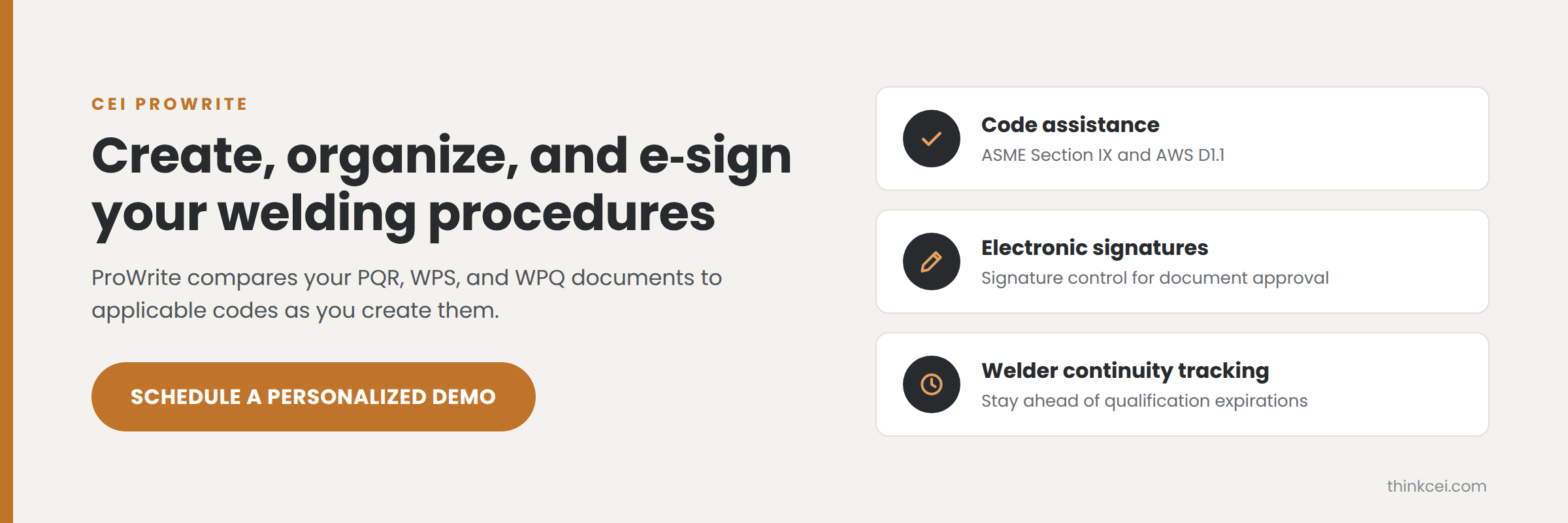
CEI also brings 25 years of dedicated expertise in welding procedures and code compliance. When you contact support, you reach engineers who understand ASME Section IX variables, not generic technical support staff. That depth of knowledge is why quality managers and Certified Welding Inspectors continue to rely on CEI for their documentation challenges. Schedule a personalized demo to see how ProWrite handles your specific code requirements and approval workflows.
FAQs about welding approval software for ASME teams
What is welding approval software?
Welding approval software manages the creation, review, and authorization of welding procedure documents such as WPS, PQR, and WPQ records. CEI ProWrite automates this process with code-assisted document creation that validates essential variables against ASME Section IX and AWS D1.1 during authoring.
How does welding documentation software help with ASME compliance?
It checks your welding procedure documents against current ASME Section IX code requirements as you build them, flagging errors before they reach review. CEI ProWrite includes built-in code logic for essential variable validation, automated welder continuity tracking, and ready-to-submit compliance reports.
Can welding procedure software track welder qualifications?
Most dedicated welding procedure platforms include welder qualification tracking with continuity monitoring. CEI ProWrite goes further by sending automated expiration notifications and linking each welder's qualifications directly to the procedures they support, so your team stays ahead of requalification deadlines.
What codes does CEI ProWrite support?
CEI ProWrite supports ASME Section IX, AWS D1.1, API 1104, BS/EN/ISO welding codes, MILSPEC, and NAVSEA standards. This breadth of code coverage lets teams working across commercial, pipeline, and defense fabrication manage all their procedure documentation from a single platform.
Is cloud-based or on-premise welding software better for fabrication shops?
The right deployment depends on your IT environment and access requirements. CEI ProWrite offers both cloud-based and on-premise options. Cloud deployments reduce IT overhead and provide access from any location, while on-premise installations give shops with restricted network access full control over their data.



Leave a Comment